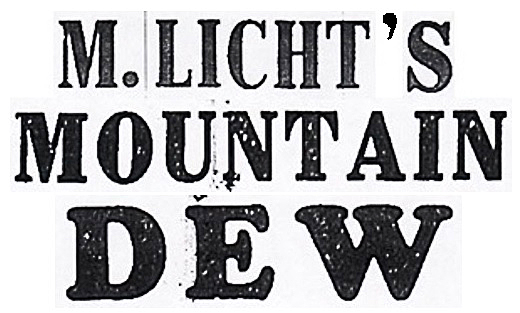
While the feud still rages over the creation of the modern flavor of Mountain Dew, and who bottled the brand first, a recent discovery by a bottle collecting friend of mine, Mike Madden, in Knoxville Tennessee indicates that the roots of the brand run even deeper than the Hartman Beverage Company of Knoxville. Mike's discovery is an ad from a 1928 Knoxville newspaper advertising the "Dew Beverages" line which is manufactured by the M. Licht & Son Bottling Company located at 611 South Broadway in Knoxville, Tenn. At the very top of the ad is the phrase "Ask For Mountain Dew: A Pure Lemon Thirst Quencher. It's sparkling white."(2)
Max Licht started his condiments manufacturing company in 1889 at 1214 E. Jackson Avenue in Knoxville Tennessee.(3) At the same location in 1903 his occupation in the city directory is listed as pickle manufacturer, and he moves to 611 South Broadway in 1904.(3) There is still no listing of any bottling being done by Max at this point, but that changes in the 1907 city directory. In fact we are given a whole line of products that he is producing now including pickles, vinegar, kraut, and operating a cider bottling works.(3) It appears that Max has decided to get serious about bottling by 1909, and names his company M. Licht's Bottling Works.(3)
In late 1912 Max Licht sells his entire bottling operation to the Marble City Bottling Works according to the August Issue of the American Bottler magazine.(7) In fact in the 1912 city directory Max Licht is listed as producing extracts and vinegar at 611 1/2 South Broadway.(3) He continues producing these products until 1915, when the M. Licht bottling works is resurrected again in the basement of 611 South Broadway.(3) There may have been a two year hiatus for the M. Licht Bottling Works, because there is no mention of him operating any business in the 1919 and 1920 city directory.(3) In 1921 the name of the company is now M. Licht & Son; however, there is no son listed, but we know that the son refers to Leonard D. Licht who is listed as a student in the 1922 city directory, as bookkeeper for the company in 1923, and as salesman for the company in beginning in 1924.(3)
The "Deco Bottle" craze of the 1920's pretty much required that bottlers either purchase deco bottles or risk getting over looked in the soda cooler. M. Licht & Son saw this trend and created their own unique design which they advertised as "in a bottle like a barrel".(2) In fact the bottle does look like a barrel that has gone on a diet, but is one of the more unique deco bottles I've come across. They applied for a patent on the bottle on November 15, 1927, and was granted it on January 24, 1928.(4) They used the bottles for their flavor line, Dew Beverages. The Dew Beverages line includes Grape Dew, Strawberry Dew, Root Beer Dew, and Pale Dry Ginger Ale Dew.(2) The head line beverages advertised are Hun-nee Dew "It's Pure Honey and Orange Juice", and Mountain Dew with the tagline "A pure lemon thirst quencher (it's sparkling white)".(2)
Steve Hicks' "History of a Rare Knoxville Bottle" which was published in a local bottle club magazine in the early 1990's, notes that this bottle was a quite rare Knoxville bottle.(5) Some even claim that the barrel bottle was only used in 1928. According to the current owner of M. Licht & Son, a descendant of Max, they found it hard to compete with Nehi which was just starting to gain popularity in 1928. Just from looking at one month of the Knoxville newspaper, I can see this is quite true. For one M. Licht & Son Dew Beverages ad in the entire month there had to have been three Nehi anti-imitator ads per issue of the newspaper.(2) Nehi was definitely out to eliminate their direct competitor Dew Beverages, and they had a very large parent company behind them providing money and advertising to do so.
Even with this kind of pressure from their larger competitor M. Licht & Son continued to bottle carbonated beverages until 1931.(3) It was in the September 15, 1931 issue of the National Carbonator and Bottler that it is announced that the "New" Orange Crush Bottling Company was then in operation at 1921 Magnolia Avenue (6), which had earlier that year been an indoor golf course.(3) This new bottling company was operated by J. A. Connary and Bernard F. Hartman with Aloysius A. Hartman, listed in the 1932 city directory as Aloys, as plant supervisor.(3)
The Hartman's had been partners in an Orange Crush franchise in August, GA along with Fred S. Gould, who also operated the Orange Crush Bottling Company of Atlanta, GA. The bottling equipment from the Atlanta plant had been sold to the Orange Crush Bottling Company of Johnson City, Tennessee in February 1929, seemingly after having gone out of business, but Gould was still listed as part of the partnership with Bernard F. Hartman in Augusta, GA in the 1930 Beverage Blue Book.(8)
In the 1932 city directory M. Licht & Son are no longer listed under "bottlers-carbonated beverages", but under another listing "Bottlers-Mineral, spring, and distilled water".(3) It appears that after his long fought struggle against the larger Nehi brand Max decided to enter the bottled water market, which didn't require the same equipment as carbonated beverages. M. Licht & Son is still bottling water in 1933; however, by 1934 they are producing vinegar again.(3)
Interesting to note this bit of information gives us our best clue as to what bottles, and equipment, he was using to bottle his water. The current M. Licht & Son website's history notes that during the Depression Max was one of the first to bottle vinegar in gallon jugs instead of in barrels. So he was bottling his water in gallon jugs, which gave him the ability, and idea, to produce vinegar in the same package, and had no need for carbonated bottling equipment. Thus it appears that sometime during 1931 M. Licht & Son sells its bottling operation, which it had done before back in 1912.
My question is did the Hartman's move the bottling equipment from the Augusta plant to Knoxville, or did they purchase an existing bottling operation from Max Licht? The Augusta plant was in bankruptcy, which may have meant they now longer owned this equipment, and given the long haul of the equipment to Knoxville if they did, I'd say that most likely J. A. Connary who was already in Knoxville purchased Licht's bottling equipment, bottles, brand names, and formulas(?) to start the "New" Orange Crush Bottling Company by September 1931. At the very least the Hartman's were in Knoxville when Licht stopped bottling, thus aware of the line.
In 1934 Bernard F. Hartman and Aloysius A. Hartman, listed as Aloyies in the directory, are now President and Vice President of the renamed Orange Crush Beverage Company.(3) They would later acquire the Pepsi-Cola franchise, and rename the company the Hartman Beverage Company.(3) In search for a lithiated Lemon mixer of their own, they create a soft drink they call Mountain Dew, and in 1951 they purchase green and clear bottles intending to bottle a flavor line based around the name, essentially Mountain Dew Beverages.(1) It appears that they decided to modify the flavor line's name to the Hartman's Beverages Line in 1952 in a larger 10oz bottle, and continue to bottle the lithiated lemon Mountain Dew as a standalone brand in the green bottles. Hartman's Beverages would continue to be bottled in 8 3/4 oz bottles in the mid to late 1950's until sometime in the 1960's. M. Licht & Son still exists today producing their Smoky Mountain Low Calorie Sweetener.
The fact that we have a soda being bottled by two different bottlers, in the same city, with the same brand name, and the same lithiated lemon flavor, moves the idea that there is a connection from mere coincidence to fact based hypothesis. I hypothesize that the Hartman's knew about Licht's Mountain Dew, either by purchasing the formula along with the equipment from Licht, or having known about it from visiting Knoxville in preparation of establishing the Orange Crush franchise there. According to the descendant of Max Licht, Bernard Hartman and Max Licht did know each other in later years, he could have easily just told Hartman about the brand at some point. Max Licht's Mountain Dew deserves its place in Mountain Dew history, if not directly then as the origin of the idea which its creation was based on.
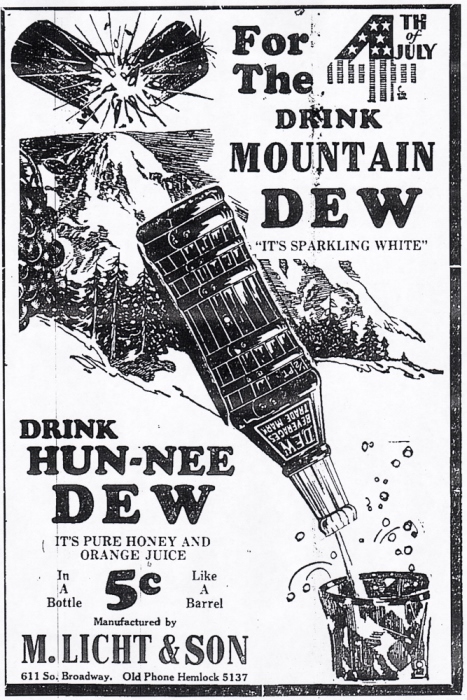
M. Licht & Son Dew Beverages ad from July 3 1928
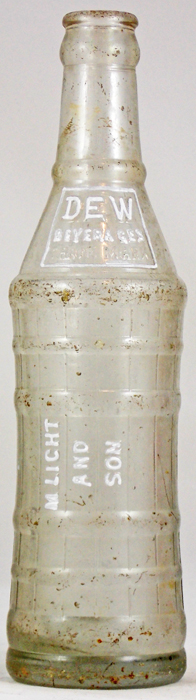
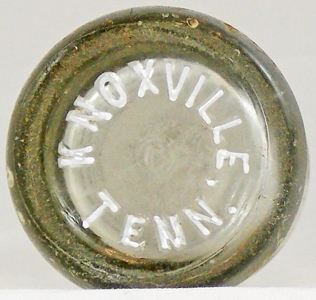
8oz Dew Beverages bottle
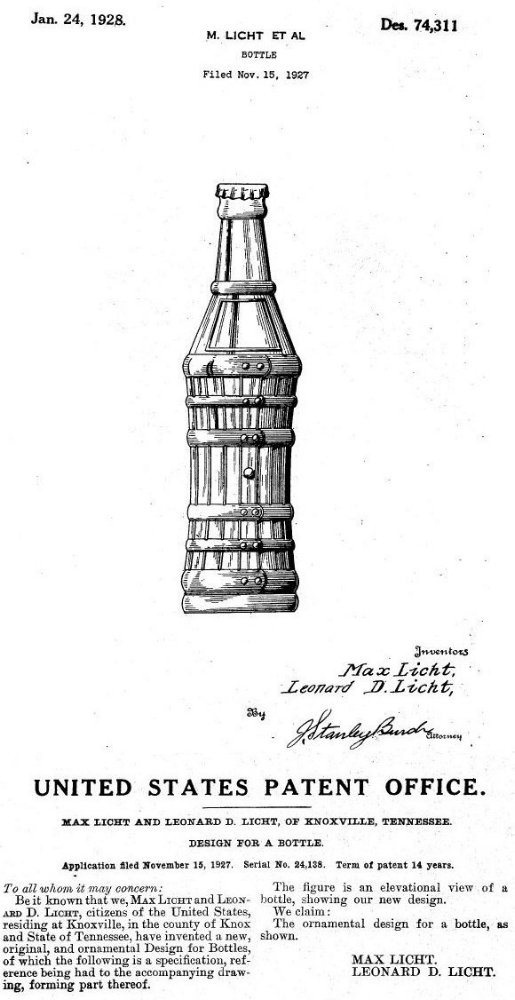
Patent design belonging to Max Licht
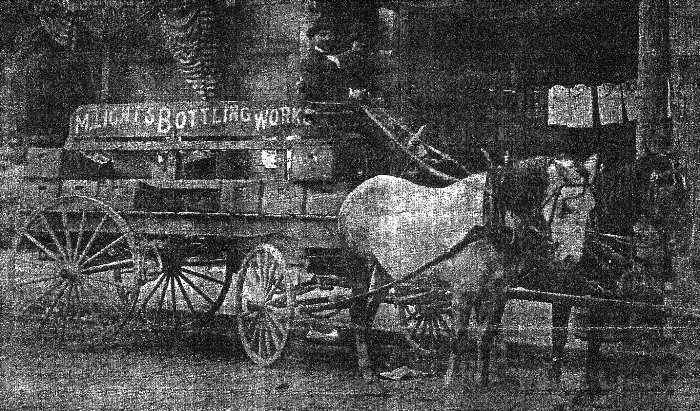
M. Licht Bottling Works wagon
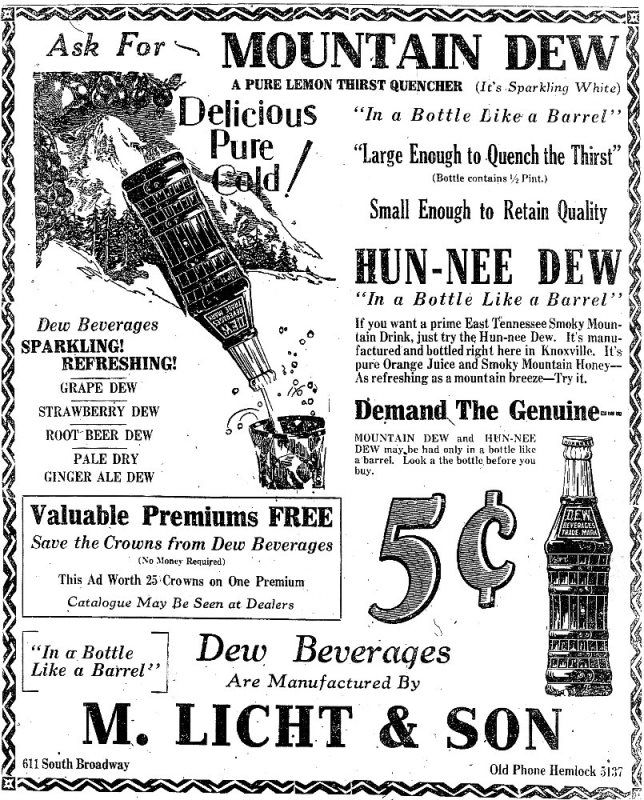
M. Licht & Son Dew Beverages ad from 1928
This page is only part of a much larger site. To see the rest then just click TAZEWELL-ORANGE.COM
Tazewell-Orange.com and the contents on this site are copyrighted by Joseph T. Lee III except where otherwise noted see Terms of Use.
(1) Mountain Dew: The History By Dick Bridgeforth
(2) Knoxville News Sentinel
(3) Knoxville City Directory
(4) Google Patent Search http://www.google.com/patents
(5) “History of a Rare Knoxville Bottle” by Steve Hicks
(6) National Carbonator and Bottler magazine
(7) American Bottler magazine
(8) 1930 Beverage Blue Book