TAZEWELL MANUFACTURING COMPANY
WAS-COTT / SUN-RISE BOTTLING COMPANY
The Clinch Valley News reported on May 3, 1899 that a new wholesale grocery house at Kelly (North Tazewell, VA) was going to be established.(1) The firm was called Scott & Dinguid Brothers which was owned, and operated, by Mr. William Armistead Scott, Jessee T. Diuguid, and George A. Diuguid, Jr. both of which were from Lynchburg, VA.(1) The company would be dissolved in May 1901, with the Diuguid’s leaving the organization in the hands of William Armistead Scott who renamed it W. A. Scott & Company.(1) On October 6, 1910 the Clinch Valley News noted that the foundation for an addition to the W. A. Scott & Company building had been completed, and the rest of the new structure was being built.(1) This new addition is most likely what would become the Tazewell Manufacturing Company, and the place where Was-Cott Ginger Ale was born. According to W. A. Scott his ginger ale formula was based on a formula brought over from England, and was being produced at the old tavern on Main Street in Tazewell, in the 1870’s.(1)
W. A. Scott placed the first ad for his new carbonated soft drink on September 8, 1911.(1) This original ad had the name as “W. A. Scott’s Ginger Ale”; however, this mistake was quickly corrected the next week, and Was-Cott Ginger Ale was introduced to the Tazewell County area.(1) Scott wasn’t satisfied with just supplying Tazewell County, and the surrounding counties, he envisioned a much broader distribution area. By 1913 he was shipping large shipments of the beverage to points as far away as Nortfolk, VA.(1) Large shipments were also being made daily to different sections of the country, and eventually to other countries, not bad for a product from the Appalachian Coalfields. Along with the Ginger Ale they are also producing Was-Cott Mineral Water to satisfy the spring water craze that was going on during the teens and twenties.(2) Things appear to have been going well for W. A. Scott & Company, along with the Tazewell Manufacturing Company; however, tragedy struck just after noon on January 15, 1920 when a fire broke out on the top floor of the building.(1) The blaze had reduced the entire building to a smoldering ruin by half past two o’clock that afternoon.(1) Bystanders were treated to free Was-Cott Ginger After the fire was put out, and W. A. Scott, who had plenty of insurance on the structure, started planning the building’s replacement.(1) It appears that a couple of the other towns in the area were making very tempting offers to Scott to relocate to their towns; however, it appears that they were in vain.(1)
In order for the company to keep operating Scott had to work fast. Stras Harman and Company gave him some space for his clerical workers in their building, and he leased a building belonging to the Star Milling Company on a temporary basis into which he moved some of his new machinery in order to continue bottling.(1) The Was-Cott Corporation was incorporated on April, 23, 1921, with W. A. Scott as President/Treasurer, George W. St. Clair as first Vice President, both of Tazewell, VA, Hiram T. Gates of Richmond, VA as Second Vice President, and F. H. Forbes of North Tazewell, VA as Secretary. Jameson George Buston is one of the directors of the company; he will become more important to the company in the future. The Austin Construction Company of Philadelphia got the contract to construct a new three story brick and concrete plant, including a basement, and equipped it with the most modern machinery available at the time.(3) They started construction in August 1921 and had forty five working days to complete the building. In fact this new building was heralded as one of the largest bottling plants in the state of Virginia. Scott had built the new plant in the same location as the old building, across the tracks from the Norfolk & Western Railway station. This time he added a rail spur in front of his loading dock to make the shipping of his product much more efficient. An intensive advertising campaign was implemented which would eventually reach the entire country thus creating many distributors who would need product supplied to them via rail.
Eventually Was-Cott was picked up by The Great Atlantic & Pacific Tea Company, who owned the A&P grocery store chain, to be distributed in their establishments all over the eastern United States. Was-Cott Ginger ale was produced in three sizes of amber bottles, with paper labels, the 7 ½ oz selling for five cents, 12oz sold for ten cents, and the 16oz for twenty cents.(1) The mid-twenties starts seeing some changes at the Was-Cott Corporation, originally only producing ginger ale and mineral water, Scott seems to be picking up franchises for national drinks while also changing the bottle color and labels for his signature product. The Was-Cott Corporation is bottling three types of Was-Cott Ginger Ale (regular, club, and extra dry), Orange Crush, Lime Crush, Cherry Crush, Strawberry Crush, Mandalay Punch, Hires Root Beer, Apple, and Peach products by 1928.(1) When the Depression hit in 1929, it seems to have affected the Was-Cott Corporation adversely as we find that W. A. Scott is selling automobile and life insurance by June 6, 1930.(1) On August 29, 1931 the Was-Cott Corporation’s bottling plant was sold at public auction where it was purchased by W. A. Scott’s brother in law, Jameson G. Buston, who had been a member of the board in the former corporation, and held the job of Receiver at the plant.
J. G. Buston’s era is the reason that this company is my favorite local bottler. He changed the name to the Sun Rise Bottling Company and decided to create his own soda brands even referring to the company on a 1930’s bottle opener as the Sun Rise Flavor Company. The first was the bread and butter of any bottler, a flavor line named Sun Rise Beverages, along with “Giant” Was-Cott Ginger Ale, and a Ginger Beer going by the name Giant Chro-Mo which they trademarked on December 20, 1934.(4) One of the most mysterious brands from the Sun Rise Flavor Company is Love’s Dream which was trademarked on April 23, 1932 (4), and was sold with the tagline “Dedicated to the American Woman” which leaves me wondering what flavor this brand was. Then there is Dixie Belle Sun Rise Flavor’s first cola which was trademarked on September 11, 1936.(4) I’m sure there are still more brands that were created by this company that we just don’t have any information on yet.
By the end of the 1930’s the company has started using ACL (Applied Color Label) bottles, and now have new brands including Lucky Giant Cola “A franchise Drink”, which makes me think that they actually tried their hand at franchising one of their brands. Tazewell Orange “A Delicious Drink” which although trademarked on November 23, 1943 the company claimed they had been using since 1931.(4) Then there is 2 TO 1, "Two to one you’ll like, because it’s two to one in your favor" which was a Lithiated Lemon soda trademarked on June 2, 1939.(4) Another one that was filed for trademark on April 1, 1939, after having been created in February of the same year is something called You And Me, yet again we don’t know what flavor this was.(4) Last but not least we have Rhythm Punch with the inspired tagline "Tastes like grapes" which while being trademarked on December 3, 1943 was created in November 1940.(4)
Many of these new brands created by Sun Rise Flavors didn’t seem to make it past the World War II. Giant Chro-Mo and Love’s Dream don’t seem to have survived the 1930’s, Lucky Giant Cola, which most likely replaced Dixie Belle as the company’s cola, and 2 TO 1 appear to have disappeared around 1942. The creation of new brands slows to a stop by 1944 when they pick up their first franchise drink, the grapefruit drink named Squirt.(1) The company actually shut down for a short time during the war most likely due to the sugar shortages, and their employees joining the war effort.(1) Other bottlers continued to operate, but rationed their products to the public. The Sun Rise Bottling Company was registered as a partnership on March 24, 1947 comprised of Jameson George Buston, Earl Stanley Wallace, and John Wharton Gillespie, the former commonwealth’s attorney for Tazewell County.(5) April 1948 the bottling company acquired a franchise for Red Rock Cola, followed in June 1948 with a franchise to bottle Hires Root Beer.(6) Hires Root Beer had originally been bottled in Tazewell during the Was-Cott Corporation era. By October 1948 Buston has sold his interest in the company to Wallace and Gillespie, and the company finally received the equipment they had ordered for a complete refit of the bottling plant.(2)
The creator of this company, and its most famous product Was-Cott Ginger Ale, William Armistead Scott died in March of 1950 (1), soon followed by Jameson George Buston on December 24, 1950. The nineteen fifties would become an era of changes at the Sun Rise Bottling Company. By 1953 the company is bottling Red Rock Cola, Hires Root Beer, Squirt, Rhythm Punch, Tazewell Orange, Was-Cott Pale Dry Ginger Ale, and Sun Rise Beverages. This wasn’t to last as by 1955, the brand that had started it all, Was-Cott Ginger Ale had been dropped in favor of Canada Dry Ginger Ale because the latter’s rise in popularity nationwide was eclipsing Was-Cott in sales. Wallace and Gillespie also sold the trademark to J. G. Buston’s creation "Sun Rise" Beverages to Sun Rise Inc. of Marshall, MN, whether or not the brand itself was sold or just the name is still unclear to me; however, the Sun Rise Bottling Company is listed as the original owner of the trademark which Sun Rise Inc. of Marshall, MN currently owns. Sun Rise Incorporated franchised the Sun Rise Beverages brand into the 1980’s, mostly to Coca-Cola Bottlers, and the Coca-Cola Bottling Company of Winona, Minnesota bottled the brand until last year. Neither Was-Cott Ginger Ale nor the Sun Rise Beverages line show up in the advertising in 1955.
Sometime in the year 1960 the Sun Rise Bottling Company is closed, the bottles, other supplies, and bottling equipment is sold to the Pepsi-Cola Bottling Company of Norton, VA, the owner of which made a practice of buying up smaller bottlers so that they wouldn’t be bought by others to compete against him. This on the surface seems kind of cruel; however, his actions made perfect business sense, and actually ended up saving many of these company’s bottles for future generations. This makes him a hero in this researcher/collector’s opinion. The plant itself was sold to the locally based Deskins Supermarket chain which bricked up the windows in order to convert it into a warehouse which was in use until the company went out of business several years ago. The building now stands empty, a monument to the bustling business community that was once North Tazewell, VA.
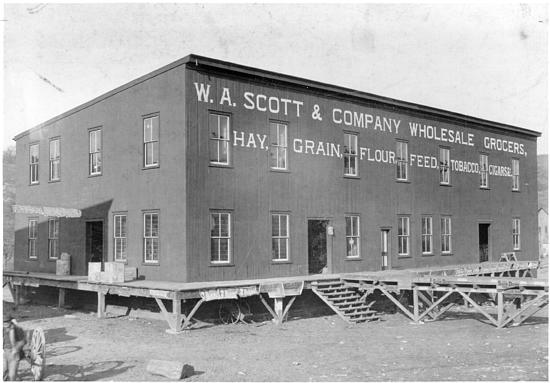
The W.A. Scott Wholesale Grocery building before 1920
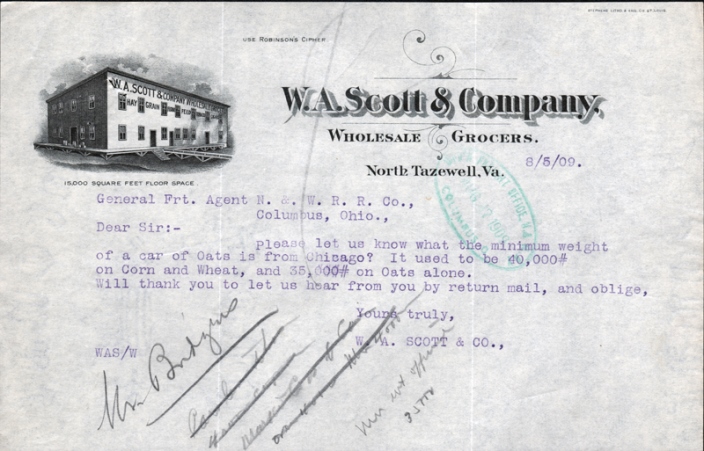
The W.A. Scott & Company receipt from 1909
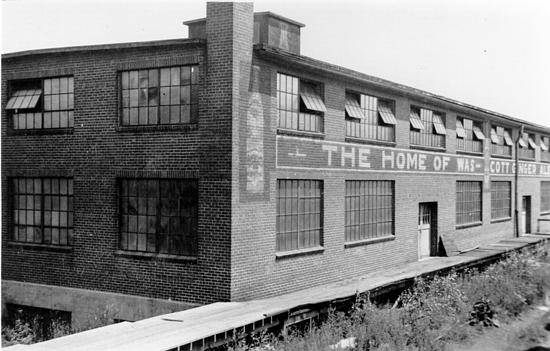
The new Was-Cott bottling plant built in 1921
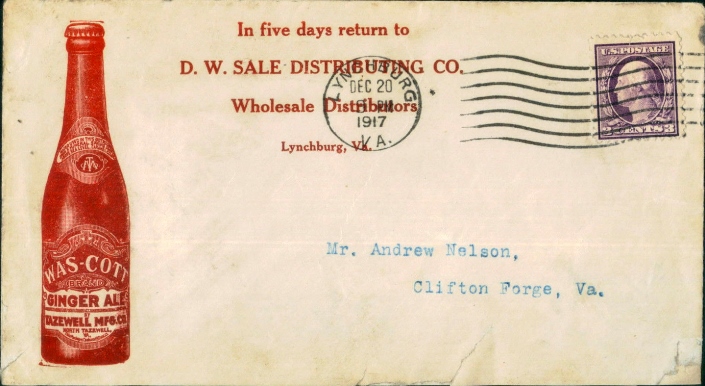
Envelope from D. W. Sale Distributing Company of Lynchburg, VA postmarked December 20, 1917. Can you guess what they were distributing?

The Sun-Rise Bottling Company as it stands today
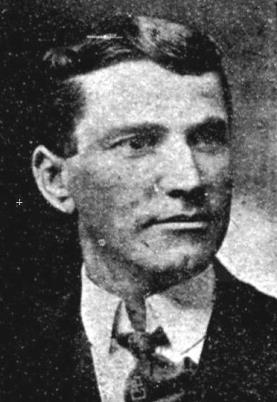
W. A. Scott from the April 23, 1909.
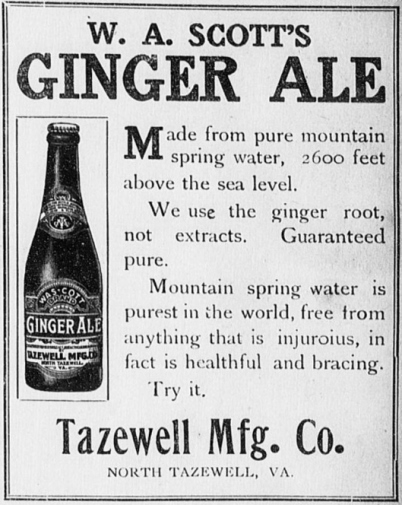
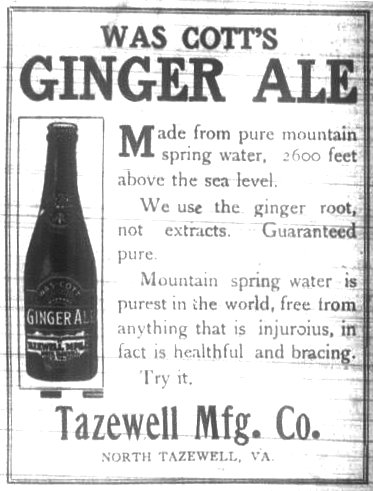
The first ad for Was-Cott Ginger Ale from September 8, 1911. If you will look closely you will notice that the ad on the right has the name of the product W. A. Scott's Ginger Ale which was quickly changed the following week to the ad on the right which is the correct name.
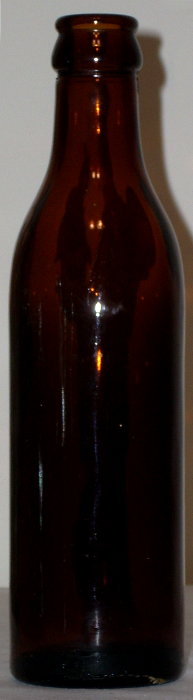
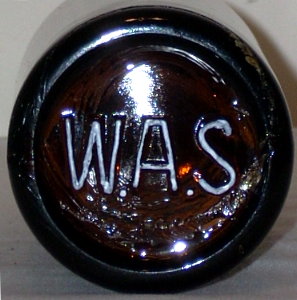
7oz Was-Cott paper label dated 1920
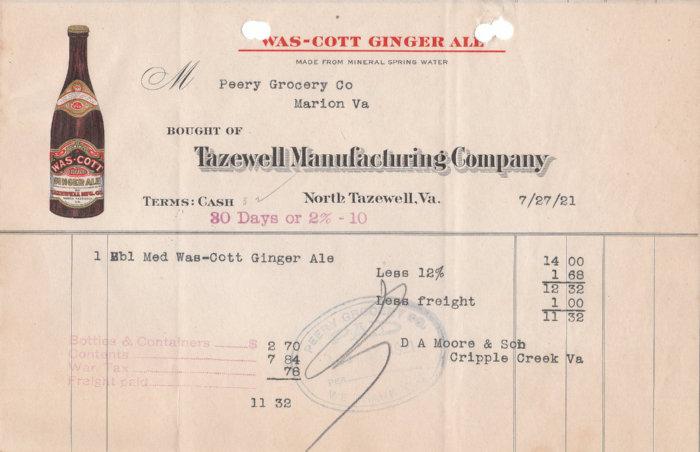
Tazewell Manufacturing sales receipt from 1921, note that the only drink advertised is Was-Cott Ginger Ale.

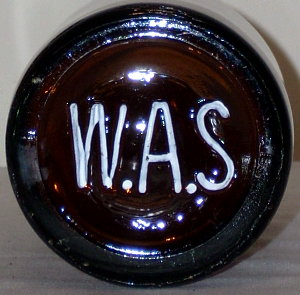
12oz Was-Cott paper label with "Was-Cott" embossed on the shoulder dated 1924
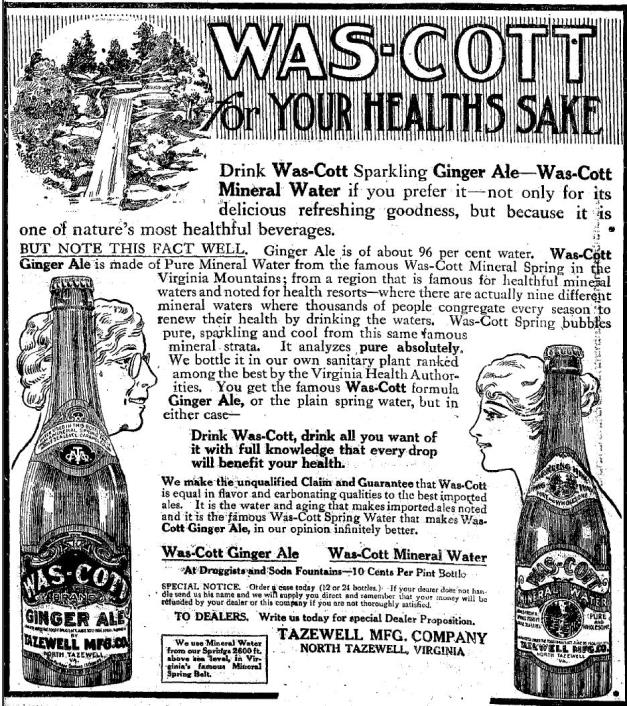
June 6, 1915 ad for Was-Cott Ginger Ale and Mineral Water

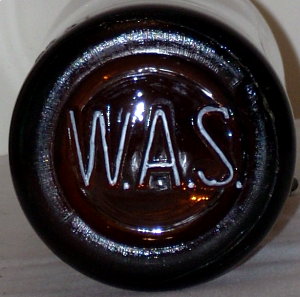
16oz Was-Cott paper label with "Was-Cott" embossed on the shoulder dated 1924

May 17, 1917 ad for Was-Cott Ginger Ale
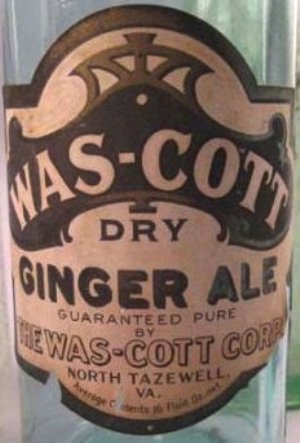
Was-Cott Dry Ginger Ale paper label.
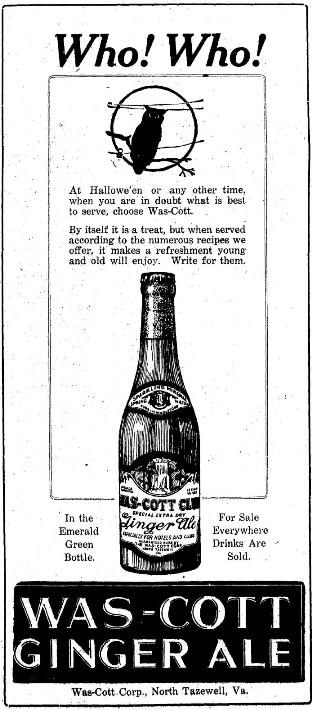
October 24, 1926 ad for Was-Cott Ginger Ale
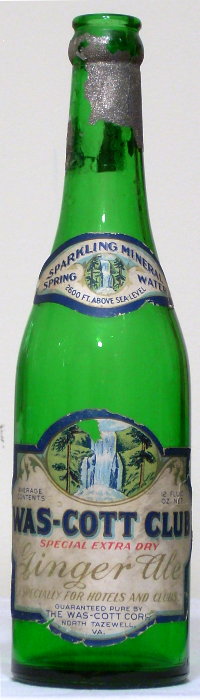
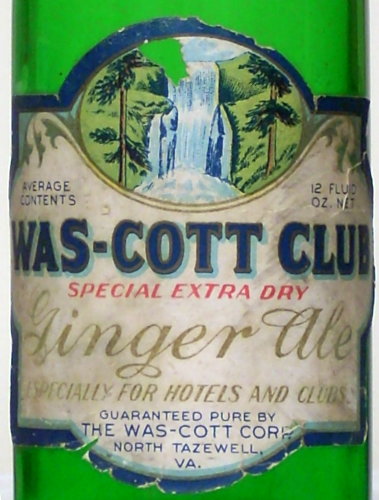
Was-Cott Club Extra Special Dry Ginger ale paper label bottle dated 1927
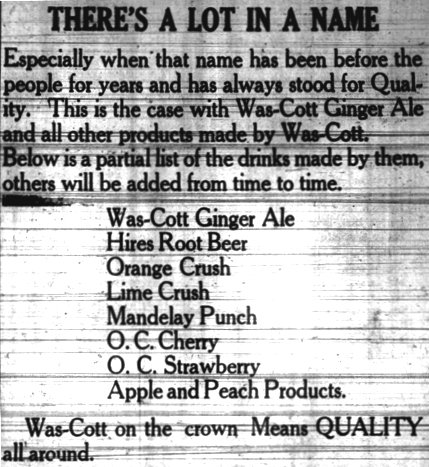
January 18, 1928 ad from Was-Cott Corporation

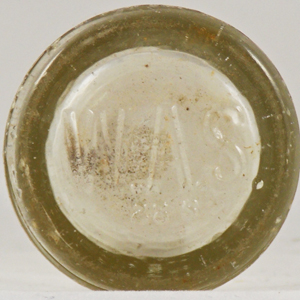
7oz clear paper label bottle dated 1928
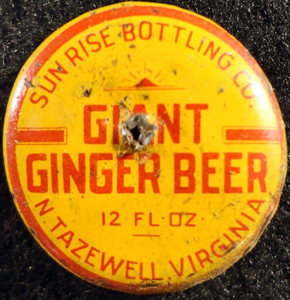
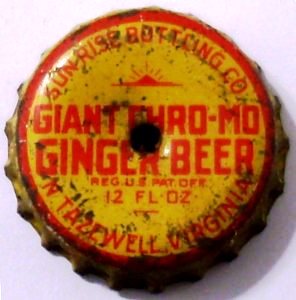
Giant Ginger Beer and Giant Chro-Mo Ginger Beer bottle caps

Giant Chro-Mo Ginger Beer and Was-Cott Ginger Ale ad from 1935

7oz Love’s Dream bottle dated 1933

Bottle opener from the Sun Rise Flavor Company for Love’s Dream “Dedicated to the American Woman”, and we still don’t know what flavor this brand was.
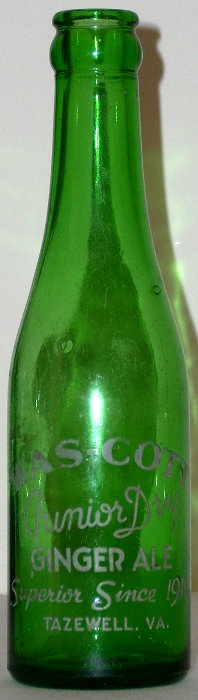
7oz Was-Cott Junior Dry dated 1936. This bottle is a very early acl (painted label) bottle, the process was thought to have started around 1936 and the earliest examples were very simple, notice that this one has no neck label, back label, or the frame that was added to the later versions.
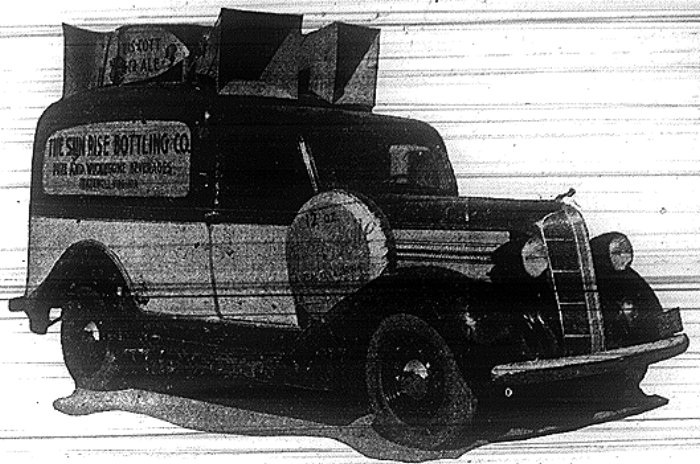
The Sun Rise Bottling Company bought a "sound car" which it introduced at the Tazewell County Fair in September of 1938. Here is a picture of the truck that was published in the Clinch Valley News on September 23, 1938.
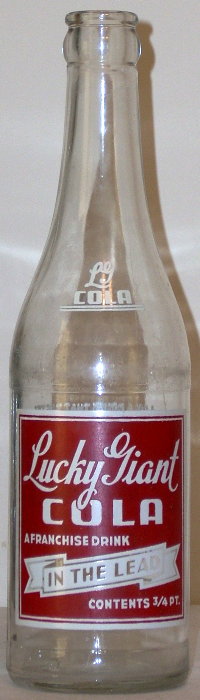
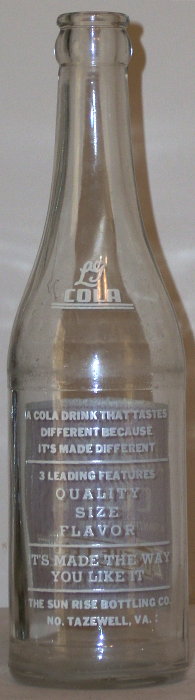
3/4 of a pint (12oz) Lucky Giant "Cola" bottle dated 1939
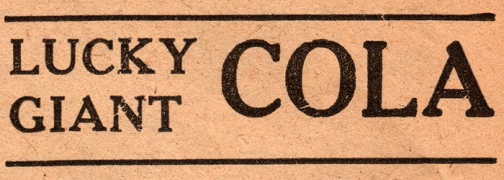
1939 Lucky Giant ad

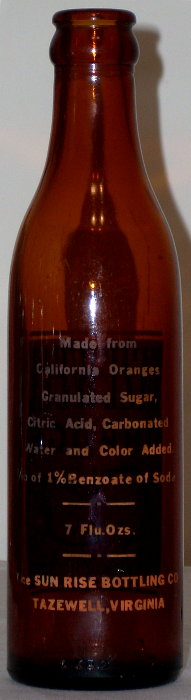
7oz Tazewell Orange (no oranges on neck variation) dated 1939.
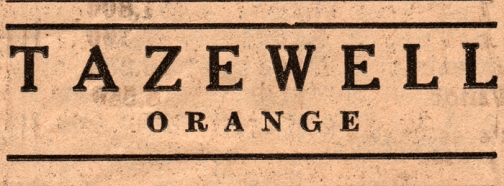
An ad for Tazewell Orange from 1939
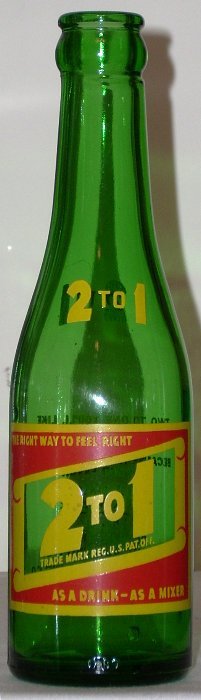
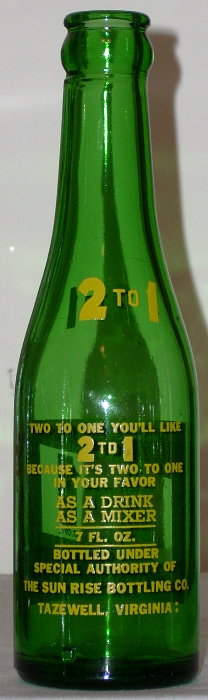
7oz 2 to 1 bottle dated 1940

A small 2 to 1 ad
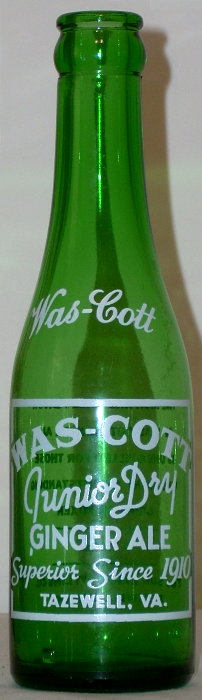
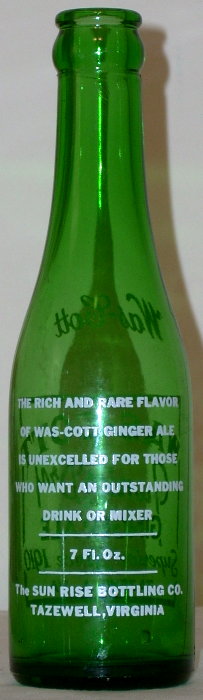
7oz Was-Cott Junior Dry dated 1940
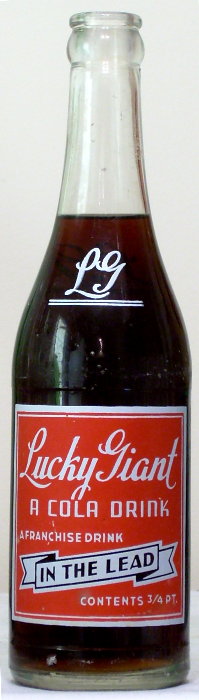
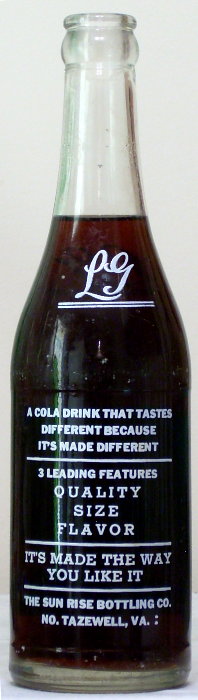
3/4 of a pint (12oz) Lucky Giant "A Cola Drink" bottle dated 1940
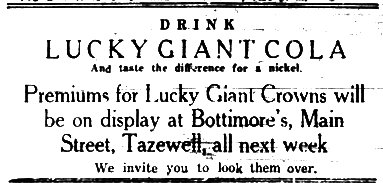
Janurary 19, 1940 Lucky Giant ad


12oz Sun Rise Beverages bottle dated 1940

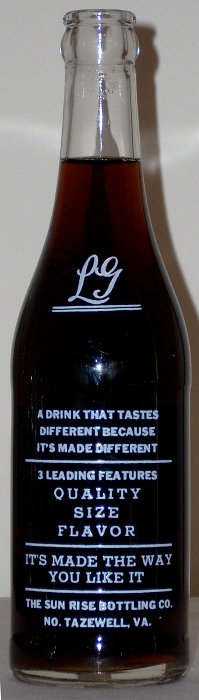
3/4 of a pint (12oz) Lucky Giant bottle dated 1941
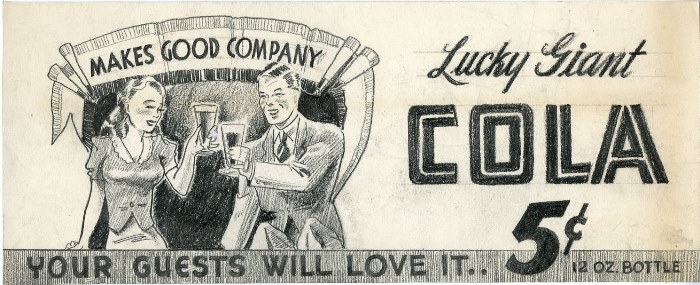
Drawing for an advertising piece promoting Lucky Giant Cola
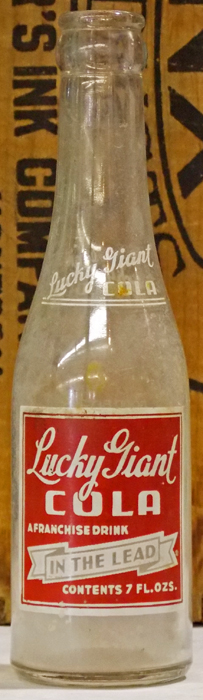
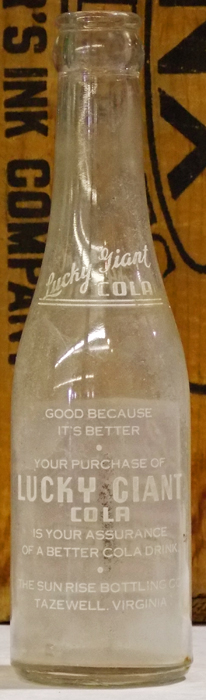
7oz Lucky Giant bottle dated 1942
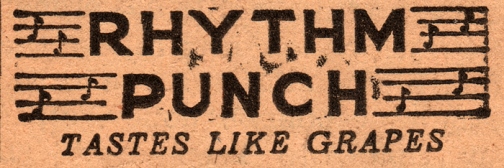
A Rhythm Punch ad from 1942
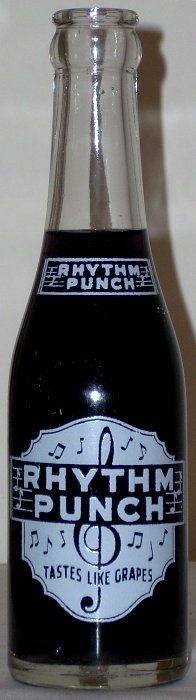

7oz Rhythm Punch bottle dated 1943
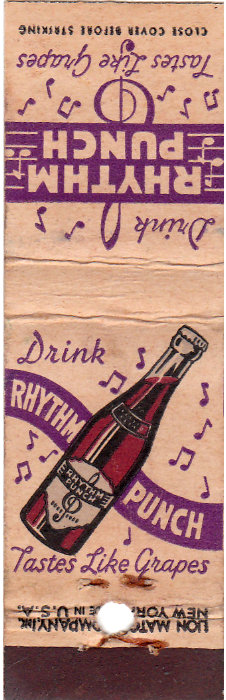
A Rhythm Punch "midget" match book cover produced by the Lion Match Co. from 1934-1943. It measures 3 3/16" x 1 1/8" in size.
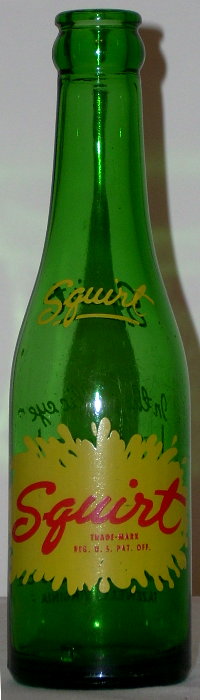
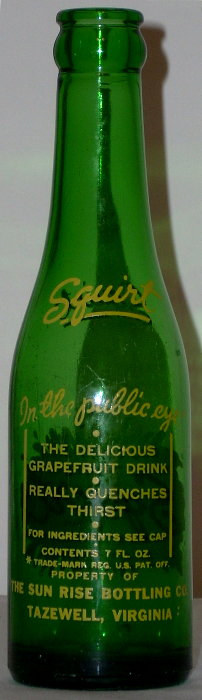
7oz Squirt bottle dated 1946

1944 Squirt ad

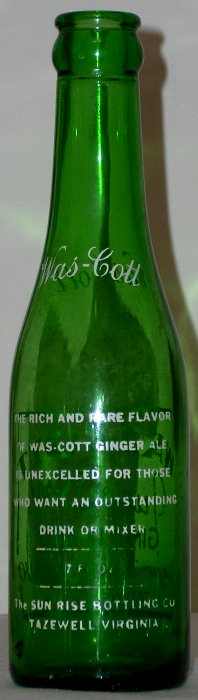
7oz Was-Cott Junior Dry dated 1947

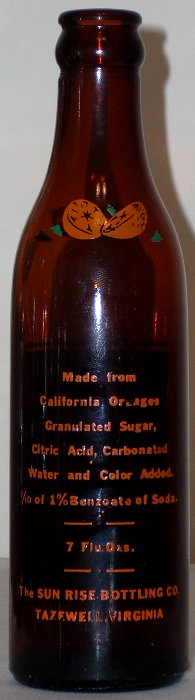
7oz Tazewell Orange dated 1947
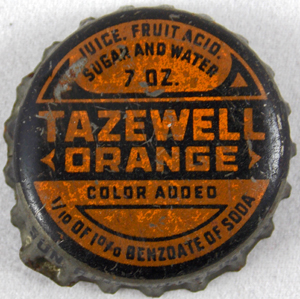
Tazewell Orange bottle cap
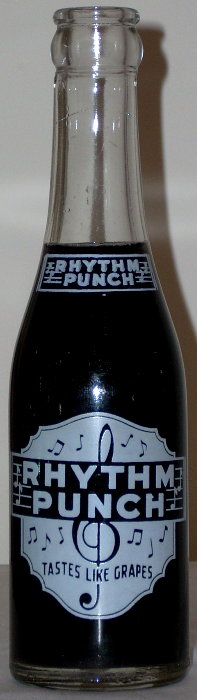
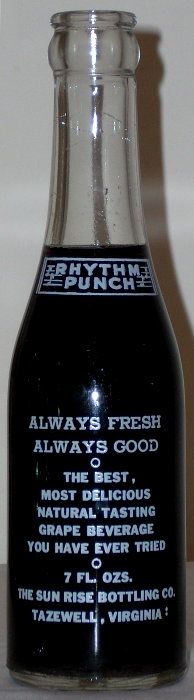
7oz Rhythm Punch bottle dated 1947
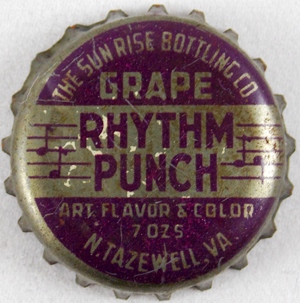
Rhythm Punch bottle cap


7oz Sun rise bottle dated 1948

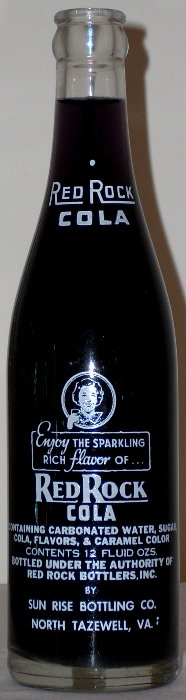
12oz Red Rock Cola bottle dated 1948


7oz Sun Rise (blue and white label) bottle dated 1951
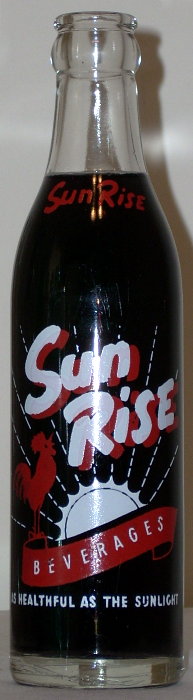

7oz Sun Rise (red and white label) bottle dated 1951
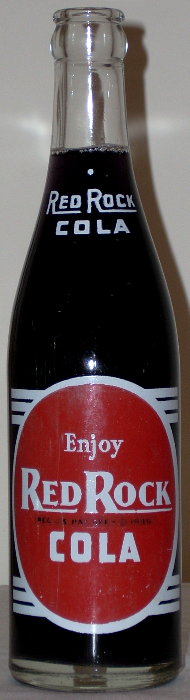
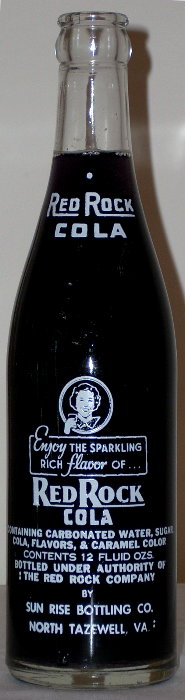
12oz Red Rock Cola bottle dated 1951

A Canada Dry crate from North Tazewell, VA

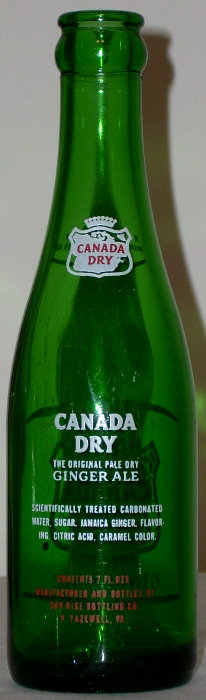
7oz Canada Dry dated 1955
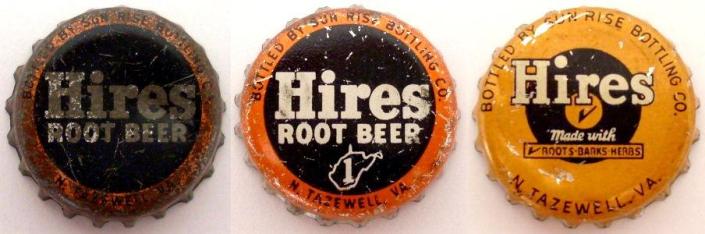
Hires Root Beer bottle caps
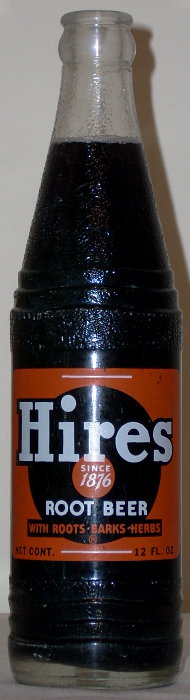
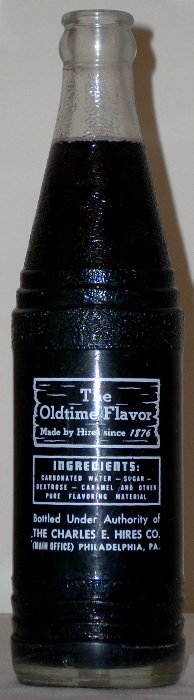
There is one problem with trying to find a Hires Root Beer from the Sun Rise Bottling plant, and that is that every Hires bottle I have ever seen seems to have only two towns on them and they seem to be the corporate offices of the company. The bottle above is a 1956 12oz Hires bottles that I can safely claim comes from the area having found several like it at a dump with a lot of other Sun Rise Bottling Company bottles, the only physical proof aside from ads are the bottle caps like the ones above.


10oz Sun Rise bottle dated 1956


7oz Squirt bottle dated 1957

Squirt bottle cap

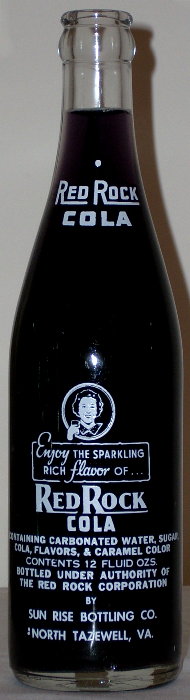
12oz Red Rock Cola bottle dated 1957
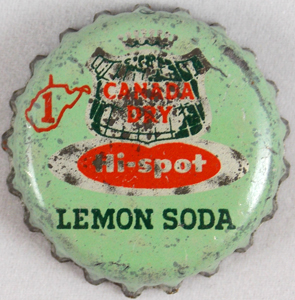
Canada Dry Hi-Spot bottle cap

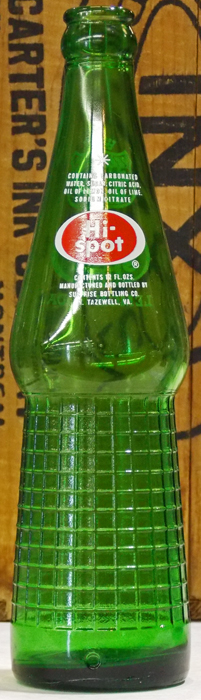
12oz Canada Dry Hi-Spot dated 1958
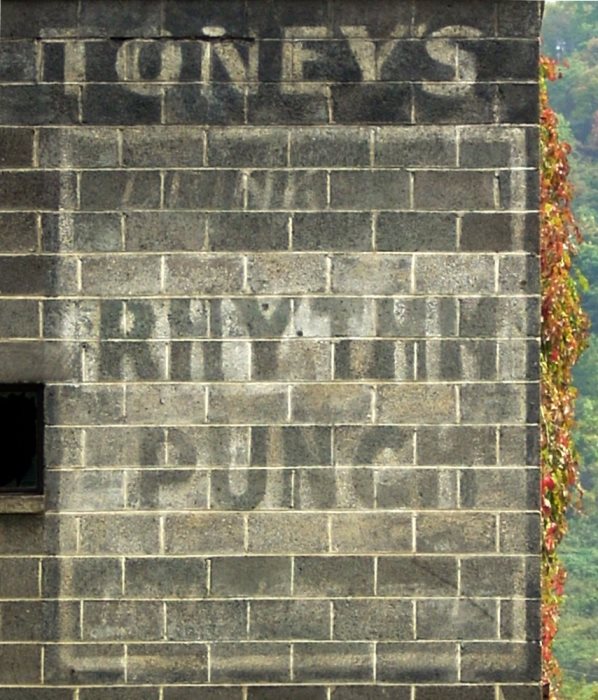
This is the last remaining piece of painted wall advertising for a Sun Rise Bottling Company brand that I know of.
This page is only part of a much larger site. To see the rest then just click TAZEWELL-ORANGE.COM
Tazewell-Orange.com and the contents on this site are copyrighted by Joseph T. Lee III except where otherwise noted see Terms of Use.
The Tazewell County Public Library for allowing me to use images TCPL 01, TCPL 02, and for the use of their resources in my research.
(1) Clinch Valley News
(2) Bluefield Daily Telegraph
(3) Brewers Journal May 1922
(4) Official gazette of the United States Patent Office
(5) Tazewell County Circuit Court Records
(6) National Bottler's Gazette